Celebrating Our Wild and Sacred Earthly Selves in Jubilant Defiance of Disembodied Spirituality
In this reverently rowdy text, Rob Brezsny proposes versions of enlightenment that don’t require an escape from our world’s gorgeous pandemonium, but thrive on a wildly disciplined engagement with it.
25.99 print edition
About the Book
Much of modern spirituality preaches escape and denial. We seekers are politely nagged to transcend our bodies, silence our desires, shed our stories, demonize our egos, downplay our feelings, and even dissolve our precious selves — as if holiness begins where humanness ends.
Enlightenment for Rebels is a raucous, lyrical uprising against that seductive illusion.
In these stories, essays, poems, and other joyously unclassifiable forms, Rob Brezsny celebrates the messy miracle of incarnation. He argues that our wounds, yearnings, and confusions aren’t obstacles to enlightenment, but the very curriculum.
Excerpts
BECOMING FINDABLE
What does it mean for us to “become findable”? How do we do it?
The playful art of becoming findable is not about chasing the goodies we want but creating conditions that enable the goodies to find us.
Imagine making ourselves visible and attractive to opportunities.
Imagine positioning ourselves in the path of luck and destiny.
Imagine sending irresistible signal flares into the great unknown.
Imagine: We can’t control what comes, but we can influence who sees us, recognizes us, and knows where to look for us.
Imagine preparation, not pursuit. We don’t hunt but ripen.
Here’s a news flash about all the hustle-culture clichés like “manifesting our dreams.” Many of them are based on the exhausting premise that we must obsessively chase down the treasures that will fulfill us.
With steely gleams in our eyes and gritty heroism in our hearts, we supposedly have to force reality to bend to our will through rugged determination and positive thinking.
The spiritual industrial complex perpetrates the same dirty trick with awakening. It sells us the idea that enlightenment is a prize we achieve through the accumulation of meditation hours, retreats, purifications, reading holy texts, and maybe some mortifications thrown in there, too.
If we just push hard enough, we will break through to the other side. Our <i>Enlightenment for Rebels</i> shuns the gospel of hustle and the spiritual industrial complex. We ignore the bootstrapping propaganda that says grind harder. For us, becoming findable is a subversive triumph. Our method is stranger and more elegant: ripen ourselves.
+
Think about how a flower attracts pollinators. It doesn’t chase bees. A lilac bush never zips around the garden trying to coax insects to visit.
Its brilliant strategy is to become so vibrantly itself—so fragrant, colorful, and rich with nectar—that pollinators can’t help but find it.
The lilac’s work isn’t to engage in pursuit but to develop its full lilac-ness. The playful experiment of flirting with enlightenment has similarities.
Awakening isn’t a possession we hunt down and capture. It arrives when we make ourselves findable to the rhythms and rhymes of grace.
This inverts the stodgy spiritual narrative. Instead of asking, “How do I corral a big shiny batch of enlightenment?”, the question morphs into “How do I cultivate the kind of soul that enlightenment recognizes? How can I position myself in the path of awakening?”
Here’s a five-step guide:
First, we get clear about our signals. What messages are we broadcasting into the world? Not what we hope we’re broadcasting, but what we’re actually emanating through our choices, attention, and energy.
Maybe we say we want awakening but we’re still performing the small self ’s drama: stalking status, accumulating grievances, defending our righteousness, and clinging to our wounds as identity.
In that case, we’re almost certainly unfindable. We are camouflaged as our false self. Enlightenment can’t detect us because we’re dressed up as the type of character that enlightenment avoids.
But let’s say we soften our defenses and question our certainties. We get curious about obstacles we might be generating. Then we begin emitting a different frequency that could make us more visible to the robust versions of enlightenment.
We Rebel Enlightenment aspirants call this “spiritual ripening.” We can’t make the fruit be ready faster by yanking on it, but we can focus on ensuring it has sufficient sun and water.
★
A second cagey strategy we can invoke to become findable is to situate ourselves in the path of awakening.
Do we want to rouse ourselves from our habit minds and studied ignorance so we can dwell periodically amidst luminous curiosity?
Then we will study people who have done it, not as celebrities we adulate but as field guides to the mysterious territory. We practice one of the myriad varieties of meditation, not compulsively but consistently.
We put ourselves in situations that crack open our chronic cycle of anxieties, like nature, art, sex, service, deep conversation, dancing, and singing. Getting educated is helpful. We can be wise and inquisitive fools who inhabit enlightenment-rich environments. We locate ourselves in ecosystems where awakening circulates.
Musicians don’t get discovered by sitting alone in their apartment. They play open mics, jam sessions, and every gig they can get. They collaborate with other musicians and speak highly of those whose artistry and soulfulness they enjoy. Do they know friends who know friends who are talent scouts? They lubricate such connections.
Similarly, awakening doesn’t usually find us while we’re scrolling Instagram and complaining about our ex. It grazes us when we’re positioned where lucidity and illumination like to hang out.
★
Here’s a third tender trick for becoming findable: Prepare ourselves to recognize awakening when it cruises into our vicinity.
The obvious secret is that enlightenment may come disguised. It shows up on an ordinary Tuesday while we’re washing dishes. It edges its way into our intuition during pauses between thoughts and transitions between appointments. Maybe it swoops down on us when we momentarily forget to cling to our tormented story about who we are.
Let’s hope we’re not rigid in our expectations about what enlightenment looks like, fixatedly anticipating floods of white light and cosmic consciousness and throbs of bliss. If we are, we may miss it when it shows up as simple, clear, ordinary grace.
Here’s a fourth tiny little gigantic action we can undertake to become findable: Remove obstacles that make us unfindable to awakening, enlightenment, or illumination—or, as we like to name it, Blazewake!, Truthflash!, or Soulburst!
Is there anything blocking our signals? Maybe it’s spiritual ambition. We’re so driven to achieve enlightenment that we can’t see we’re already in its midst.
Maybe it’s perfectionism. We’re waiting and hoping to someday be pure enough and good enough.
Maybe it’s bitterness. We’re so armored against disappointment that numinous revelations can’t reach us.
Becoming findable for enlightenment might require subtracting more than adding. It may mean banishing the static of spiritual ambition and saying no to the practices that are just ego reflexes in disguise. Then maybe we can say yes to the elegant presence that has been there all along.
+
Here’s another not-so-top-secret technique we can harness to become findable: Trust the timing that isn’t ours to control.
The seed germinates when conditions are right: enough water, oxygen, and light, plus the right temperature range.
Likewise, the blessed breakthrough of higher, deeper awareness erupts when it’s ready. We can’t force it to arrive faster by wanting it harder or meditating longer.
The timeline may be slightly under our control, but mostly not. Our main job is to keep doing the patient work of preparation. Continue practicing and questioning and cultivating receptivity, even when nothing seems to be happening.
Here’s a sweet-and-sour corollary: Becoming findable to awakening is a practice that usually works on a scale that’s only slightly visible. We’re creating conditions whose effects might not mature for years.
This is at odds with the spiritual hustle narrative, which says we have to grind ourselves into transcendence NOW through the pure force of will. Let’s sing the chorus one more time, louder and with a twist: Enlightenment is already looking for us. It has been searching and scanning for us forever. The universe wants to wake up to itself through us. We mean this literally. It’s not metaphor or poetry.
But enlightenment can only locate us if we’re not camouflaged. We’ve got to show up as we are—confused, earnest, excited, broken, willing, eager. That’s how we become fully visible. We emit a fragrant beam of YES that awakening recognizes: “Here is a soul who’s ready—positioned in my swath and prepared to receive me when I arrive.”
★
Now here comes the bridge of our tuneful anthem, the penultimate echo of the lyrical theme: The practice of becoming findable is an act of rebellion—not with raised fists and shouted rants, but with a subtle, nuanced devotion that undermines the whole game.
The mainstream spiritual market and the secular hustle culture are, beneath their surface differences, running the same operating system: You are not yet enough, and achievement will fix that.
Becoming findable refuses to feed that system. It says our souls are already legible to grace; the task is to stop concealing our gorgeous essence under greed and ambition.
In the framework of <i>Enlightenment for Rebels</i>, this isn’t a retreat from the world but a deeper engagement. It trusts reality’s own momentum rather than trying to override it with willpower.
We rebels aren’t storming the gates and jamming the traps that are supposedly guarding the lucid wild treasure of blissful realization. We are making it easy for the lucid wild treasure to find us.
★
PS: The practice of becoming findable for enlightenment isn’t separate from enlightenment itself. The preparation, positioning, and ripening comprise the awakening.
The seeking and the finding aren’t separate. We’re becoming findable because that’s what awakening looks like while it’s in progress.
HARBINGER: JOY AND GRIEF
In 2005, I published the first edition of Pronoia Is the Antidote for Paranoia: How the Whole World Is Conspiring to Shower You with Blessings.
Four years later came the expanded 400-page version, with 55% additional new material. Translated editions bloomed across the world: Spanish, Italian, Greek, and Turkish. I became the godfather prophet of pronoia.
The term itself was born in the 1970s from the mind of author John Perry Barlow, who envisioned it as paranoia’s radiant twin—“the suspicion that the universe is a conspiracy on your behalf.”
But Barlow didn’t develop the notion beyond his brief definitions. That project became my calling, and I pursued it with the fervor of an archaeologist uncovering a lost civilization. I resolved to be relentless in naming and celebrating all that is beautiful and interesting and healing in our bewildering world.
My philosophy rests on three radical propositions: that the universe is a prodigious miracle created for our amusement and illumination; that all of creation conspires to liberate us from suffering while motivating us and educating us to love with precision, intelligence, and courage; and that life delivers exactly what we need—not what we want, but what our souls require—to fulfill our deepest purposes. (PS: These worthy goals may take more than one incarnation to accomplish!)
Core tenets:
Evil is boring, sterile, and stupid.
Cynicism is intellectual laziness masquerading as sophistication.
Fear is a bad habit we can at least partially unlearn.
Despair is an impotent luxury with no redemptive power.
Joy is fascinating, revelatory, and necessary.
Love is an act of heroic genius, requiring bold perseverance and cultivated skill.
Pleasure is not an indulgence but a birthright.
Receptivity is a superpower.
But now the plot thickens: I am not a saccharine optimist who ignores life’s brutal realities. At the core of my perspective on pronoia lies an intimate, unflinching relationship with darkness. I don’t ignore or transcend shadows; I engage and negotiate with them.
Here’s a key element of my formulation: Yes, life orchestrates a vast conspiracy to keep us supplied with blessings, but what constitutes blessings? Ten million dollars? A gorgeous body? A hassle-free marriage with a perfect soulmate? A mansion filled with lavish accessories?
Maybe. But more often, the blessings arrive as plot twists we didn’t anticipate. They may bring dizzying adventures that remake us, gifts so unexpected we hardly know what to do with them, challenges that invite us to become smarter and wilder and kinder, and conundrums that dare us to grow luminous and numinous.
Among the conundrums that have dared me to grow more luminous and numinous is a tragicomic irony about my own soul’s assignment.
The realization slammed into me years ago. I was driving on Highway 1 north of Point Reyes, California after a rare argument with my beloved partner, determined to cool my troubled heart by staring at the white sky and grey ocean until they scoured me clean. A storm seemed imminent. The waves were bruised and restless.
Needing a break and wanting to write down a torrent of tormented thoughts in my notebook, I pulled over into a gravel turnout and parked. When I got out of the car, I had to concentrate on anchoring myself in the face of the steady gusts. Soon I noticed a shrine wedged down near the ground between two boulders. It was modest, but every object within it radiated stubborn endurance.
Wilted, mud-heavy lilies formed a roughly circular boundary around the ceremonial space. There were three candles in glass jars and three dead starfish. A child’s rubber boot, pink once, was now sun-blanched to a weary rose. A weather-beaten teddy bear with one eye missing, its remaining eye cloudy and scratched, gazed outward with a look of baffled tenderness.
There were messages, too: handwritten notes on thick index cards stuffed into rock crevices. Some were barely legible, half-erased by the elements:
We miss you.
Come visit us in dreams. Forgive us.
You changed us.
A few stones had been painted with spirals, hearts, and a stick-figure family holding hands beneath a wan sun. A single abalone seashell was positioned at the center like a small altar bowl, mottled with rainbow flashes whenever the clouds parted.
The whole shrine had the look of having been tended by many hands at various times, but also neglected for long stretches, as if grief came in unpredictable waves.
It was woebegone, unglamorous, and defiant in its shabbiness. I imagined it to be a shrine for a sorrow too enormous or complicated to fit into the easy categories of public mourning.
I stood before it too long. The wind moaned in strange harmonics around the rocks, like an animal circling me. The sky became a color I had never seen before, a blend of purple, silver, black and blue. A seagull’s cry cut through the wind and raised the hairs on the back of my neck. Instead of the usual squawk, I swear it shrieked my name three times: “Rob! Rob! Rob!”
Then a rupture rose up in me from solar plexus to throat: I felt an alien emotion that wasn’t mine blooming in my chest. It was a denser, older, more electric version of empathy.
The grief didn’t feel like it belonged to me, exactly, nor even to one family or one tragedy. It felt like a delta of losses converging from the whole wide world: every drowned wish, every vanished child, every unspoken apology, every hurt creature wailing in the great chain of being. I imagined it as a collective sorrow that had been temporarily stored in this heap of objects and that finally found me available and unguarded enough to hold it.
My knees buckled. I felt simultaneously enormous and hollow, as if I’d become a vessel whose only purpose was to contain this tsunami of loss. The sensation was both exquisitely precise and overwhelmingly diffuse. It was like being pierced by a thousand fine needles made of age-old sadness, each one carrying a story of irretrievable absence.
There was also a sweetness in the anguish, an alien honey-thick tenderness woven through the pain. I wasn’t drowning in it; I was being initiated by it. My chest expanded to accommodate a surge of anonymous agony I couldn’t name: the mother who never got to say goodbye, the lover who died mid-sentence, the child who vanished into an ocean, or the merciless machinery of human cruelty.
I wasn’t being punished or overwhelmed; I was being trusted. And that trust wrestled itself down into my bones like a hot coiling drill. I swore I felt it in my spine and pelvis and both femurs. It was as if I’d been chosen to receive this blessed curse because of my capacity to hold tremendous quantities of affliction that didn’t belong to me.
The sorrow carried intelligence. It had weight, temperature, and texture. It asked not for fixing or fleeing, but for presence without flinching. I felt like the grief was reorganizing me, enlarging my power to love without conditions or caveats.
As the rupture vibrated in my belly and chest, it unleashed a further breach. Mixed with the sorrow was a sense of an unmistakable assignment.
The grief didn’t merely want release. It wanted interpretation, reanimation, and alchemy. It bid me to carry it forward without corrupting it, so it would be neither sentimentalized nor weaponized. I swear I heard it speak to me: I chose you because you won’t collapse or perform martyrdom or pretend it’s not happening.
I whispered aloud, “Why me?”
The ocean answered with a rogue wave that slapped the cliffs with such force I lurched backward. In that sonic boom of saltwater and stone, I heard the unmistakable response:
Because you already praise holy beauty. Now learn to praise holy hurts.
As vividly as if it were now, I remember standing at that woebegone shrine while the vast grey Pacific Ocean shoved a massive, unwieldy truth into my bloodstream. That was the moment I fully coalesced into the living container who praises the miraculous with fervor while metabolizing the unbearable.
I fully grasped my twin assignments: to celebrate the world audaciously and carry its grief tenderly.
Ever since, I understand that my drive to gather the world’s grief springs from love: profound, unreasonable adoration for our broken, magnificent world. To earn the right to ameliorate suffering, I must first feel it as deeply as it goes. To speak authentically about bliss and pleasure, I must be intimately familiar with sorrow.
Ever since, each praise-song I write has had to carry salty tears. Every gift I offer the world is seasoned by my willingness to sit with what can’t be fixed but only felt and witnessed.
This is the harbinger’s burden and privilege: to be a bridge between what breaks us and what makes us whole. It means I’m not numbed by contradiction but buoyed by completion.
I extol the world’s beauty with ferocity precisely because I know how fragile it is. I celebrate wonder with such abandon because I can hold horror without flinching.
My initiation at the windswept shrine became foundational to everything I now understand about Rebel Enlightenment.
The disembodied spiritual traditions I reject promise transcendence from suffering. Avoid suffering at all costs, they say. They exalt an escape velocity that launches us beyond the messy, mortal realm into a sterile, pristine elsewhere.
But the liberating illuminations that have remade me again and again arrive through my willingness to be a full-bodied vessel for both ecstasy and anguish.
When I expanded to hold that collective grief without numbing or fleeing, I didn’t fly away into heavenly consolation. I dived more deeply into my life’s mission. And that descent made me exquisitely available.
Every Ecstatic Healing Derangement and Friendly Shock Awakening I’ve experienced since then has confirmed this: The sacred doesn’t seek the sanitized or the safely detached.
It hunts for those of us who are brave and brazen enough to be vulnerable, rumpled, and shockingly alive. Can we hold grief in one hand and rapture in the other without needing to choose between them?
This is the paradox at the heart of Sacramental Incandescent Embodiment: Only by refusing to abandon our earthly selves can we become spacious enough for the healing elixir of inscrutable divinity to move through us without destroying us.
WE DON'T CHOOSE TO USE DRUGS
In our fun project to evoke altered states of awareness, my Soul Team and I don’t use drugs.
Some people find it strange that we don’t call on marijuana, psilocybin, LSD, DMT, and similar technologies. A few fellow consciousness explorers regard our choice with bemused skepticism, as if we are choosing to climb a mountain barefoot.
They’re not wrong to be puzzled. Psychedelics are experiencing a renaissance. They have moved from counterculture taboo to therapeutic mainstream, from Grateful Dead concerts to clinical trials at Johns Hopkins University School of Medicine. Ayahuasca ceremonies, psilocybin retreats, and MDMA-assisted therapy are now respectable paths to the Mysterium.
Many wise guys and riot grrrls we esteem have chosen this mode of experimental exploration: Jean Houston, Terence McKenna, Robert Anton Wilson, Alan Watts, Katherine MacLean, Sara Lewis, Maria Sabina, Sonia Gray, and Rick Strassman, to name a few.
So why don’t we partake?
The short answer: We want to build doorways, not smash our way through temporary portals. Our goal is to become skillful architects of consciousness, not meandering tourists.
We want our access to The Other Real World to be a maestro trick we can summon at will, in any circumstance, without depending on any substance beyond what we ourselves can generate.
But there’s a longer answer too, and it begins with acknowledging the bounty we gained from drugs in our earlier years.
★
The Gifts We Received
My Soul Team and I aren’t snooty purists who have never touched psychedelics. In my younger adulthood, I experimented reverently with marijuana, hashish, LSD, mescaline, and psilocybin.
These technologies were generous teachers. They provided abundant evidence that our materialism-obsessed culture prevaricates about the fundamental nature of existence.
As a suburban middle-class kid from the Midwest and New Jersey, I had far to go in my quest to shed my mind-forg’d manacles. My journey was slowed by numerous detours and mistakes, but I eventually claimed my own earthy, hard-earned share of Hermetic Gnostic knowledge.
Crucially for me, my early psychedelic forays gave me wondrous gifts. They demolished any illusions I might have that the material world is the only game in town. They gave me visceral, firsthand immersion in the reality that shamans, sorcerers, and mystics have always known: that there are other dimensions and other ways of perceiving in addition to the usual stories that consensus reality insists on. For that, I am deeply grateful.
My Soul Team and I don’t look down on those who continue to use these tools. How could we? The psychedelic path is ancient, sacred, and necessary for many people. It’s among the prime practices of Indigenous cultures worldwide, as well as an often-used technology in many mystery schools.
But we understand that the very thing that makes psychedelics so powerful is also their limitation for us: their ability to blast through the barriers of ordinary consciousness solely with chemical assistance.
The Problem with Shortcuts
As I wrote in my journal during the experiments of early adulthood, psychedelics comprise a “chemical battering ram” that simply crashes through the doors of perception. There’s little adroitness or craft involved. One of my early magick teachers called drug use, no matter how responsible, “storming the Grail Castle through violence.”
That phrase lodged in my consciousness like a healing splinter.
The revelations that drugs provided were indeed hard to hold onto. As I came down from a psychedelic high, I could translate no more than 15 percent (usually much less) of my discoveries in the fourth dimension into usable understandings back in normal waking awareness. If my fantastic insights couldn’t be turned into practical improvements in my life or anyone else’s life, what good were they?
Compare this to dreamwork, which I have practiced since childhood. With dreams, I have seen steady growth, both in my unconscious mind’s ability to generate meaningful stories and in my conscious mind’s skill at interpreting them. Every night, I practice. Every morning, I remember, record, and reflect. Over many years, this has built muscles and created skills. No one can ever become a master of the dream realm, but I have gathered many riches there that serve me well in the waking world.
Psychedelics, by contrast, bypass willpower entirely. They work regardless of whether we have consciously cultivated any capacity for altered states. They deliver the experience but not necessarily the ability to integrate it, sustain it, or return to it at will.
What We’re Building Instead
When William Blake wrote that “this world of Imagination is the world of Eternity,” he gave me a revelation as profound as any drug-induced vision: that the creative imagination itself, when disciplined and cultivated, can be a main doorway to The Other Real World.
His gift changed everything. It meant that my passion for music, poetry, writing, art, dreamwork, and ritual could be at the heart of my spiritual practice. Every song I compose, every poem I write, every waking vision I induce, potentially becomes medicine with which I can shift and mutate consciousness: a method for playing wild and free in The Other Real World.
Here are other practices that can provide robust access to altered states:
Meditation: We practice multiple, ever-evolving forms. Among our baseline practices are techniques from Hermetic Qabalah and Western Magick, Sufism, the Fourth Way, and Buddhist teacher Thich Nhat Hanh. But we also celebrate the approach articulated by scholar Christopher Bamford, who said that as a free act, meditation has no fixed recipe. Every meditation is a trial run and experiment, different each time it’s done. It thrives on improvisation and play. There’s no way to “do it wrong.”
Tantric practice: Erotic play and lovemaking are spiritual technologies.
Through experiments with breathwork, prolonged arousal, feral prayers, conscious intention, and rowdy play, we generate sustained states of breakthrough ecstasy and epiphanies that can rival drug-induced bliss.
Music and movement: We drum, chant, sing, and dance ourselves into altered states. Sound and rhythm are among humanity’s oldest consciousness-shifting tools, and we deploy them regularly.
Creative work: When we write and sing with full attention and surrender, we can enter flow states that open directly into The Other Real World.
Ritual and ceremony: We create ceremonies and seek imaginal adventures that invoke spirit allies and ancestors. These are collaborative performances that inspire us far beyond what we could do alone.
An array of Alternative Enlightenment Shocks: healing transgressions and joyous what-the-fuck experiments carried out amidst the everyday routine.
The common thread in all of these? They require work and demand practice. They ask us to develop skills, build capacity, and strengthen the muscles of consciousness.
★
The Sustainable Freak Zone
Every time we successfully enter an altered state through our own cultivated abilities, we’re not just indulging in a solo breakthrough. We’re also building infrastructure in the Anima Mundi, or World Soul: what mystics from diverse cultures have called Indra’s Net, the Noosphere, the Akashic Records, the Collective Unconscious, and many other names.
We mostly name it as The Other Real World. But to ensure we don’t take ourselves too tragically seriously, we also refer to it as The Peak Freak Zone.
Consciousness explorers like us are participants in “The Great, Gorgeous, Glorious Work”: a vast interdimensional construction project that has been ongoing for millennia. Each technique we master, each successful journey we make through our own human power, adds another facet to the infrastructure that makes further exploration by others more possible.
Psychedelics are like taking a helicopter to the top of a mountain. You get to the summit, enjoy the view, and gain the revelation. But you haven’t built the trail, and you can’t guide others. You’ll need the helicopter the next time you want to return.
Our practice is trail-building. It’s slower and more laborious. But every time we make the journey, the path becomes more accessible not just for us, but potentially for other adventurers who follow.
We’re not just visiting The Other Real World. We’re creating stable portals between the realms. These portals stay open. The next time, we can access them at will. They don’t require any substance beyond our own consciousness.
The Political Dimension
There’s another reason for our choice.
When you need a substance to access certain states of consciousness, you’re creating a dependency. Not necessarily an addiction, but a structural reliance on a technology outside yourself. You need to acquire the substance. Is it possible to ensure its quality? Maybe, maybe not. If the substance is illegal, you’ve got to avoid being arrested. And chances are good you will require downtime and extra self-care to regenerate from the experience.
By contrast, these are always available for us hassle-free: our breath, our imagination, our nightly dreams, our capacity for inducing waking dreams in broad daylight, and our ability to enter altered states through movement, music, sex, poetry outbreaks, meditation, ritual, and friendly shocks. No government can criminalize them. No scarcity can prevent access. They are freely given gifts we earn through our generous and intimate relationship with the Great Mystery.
In a world of increasing surveillance and control, these concerns matter. For us, the most radical act is to take advantage of the fact that human consciousness itself, properly cultivated, is the most powerful psychedelic of all.
★
The Fuller Spectrum
Our choice comes from ambition, not primness or fear. No apologies or inhibitions: We want full access to the entire spectrum of consciousness that’s available, on demand, in any circumstance.
We aspire to enter visionary states while making love or improvising rumbustious music or dancing in the wetland mud. We want to glide into The Peak Freak Zone while hiking up Mt. Tamalpais or babbling poetry or washing dishes and sweeping the floor. Our lives must be continuously permeable to the sacred, not just during special journeys with special substances.
GRATEFUL IMMERSION IN THE GLORIOUS HUMAN MESS
My family, allies, and I are allergic to spiritual teachers and teachings that coax people to disparage the core features that make us human. We’re not sure why their sprawling quagmire seems so tempting to multitudes of souls.
They claim that the body is a distraction and desire is an affliction? We say NOOOOOOO! They insist out feelings are traps, the ego is a dire hindrance, and our personal stories are obstructions to illumination? We say NEVER!!!!!
Sorrowful dismay wells up as we watch legions of tender aspirants guzzle this fake news as if it were sacrosanct wisdom.
Our love of life protests as our fellow wanderers try to extinguish their mortal magic in the name of escapist transcendence.
We are rattled as they neglect their own precious soul savvy and demean their majestic flesh. It’s tragic and heart-breaking!
Our alternatives are celebratory rhythms and rhymes that immerse us in the glories of flesh wisdom and creature consciousness.
Resolved: We crave and deserve spiritual approaches that honor all the magnificent human features named below.
Feelings and physical sensations are sources of vigorous wisdom. They’re not erratic, banal burdens we must ignore and expunge to be free.
Desires are holy fuel for our liberation and intelligence. They’re not toxic obstacles we need to abnegate and suppress.
The ego is a crucial ally in our zeal to be vividly alive. It’s not an enemy to be demeaned and disowned, but a tool to be tuned and aligned with righteous purpose.
Many (not all) of our stories and identities are essential to who we are, where we’ve been, and where we’re going. They’re not merely illusions to vanquish and shed, but evocative texts to honor and integrate.
Our bodies are sacred vessels and sources of sublime savvy. They’re not distracting burdens but miraculous masterpieces.
Our relationships are potentially at the evocative heart of our spiritual practice, not intrusive diversions.
Earth is our beloved home, not a limbo or prison where we suffer and grieve in temporary exile from some supposedly better place.
Our incarnation on this planet is an exalted gift, not a punishment or ordeal.
Movement and sound are equally valid paths to illumination as stillness and silence.
Our everyday lives are sources of rich opportunities for delight and discovery. They’re not burdensome trials rife with irrelevant, boring, and oppressive hindrances.
Connection is just as key to spiritual deepening as solitude; community is as important as self-sufficiency; cooperation and empathy are crucial for growing our glistening sagacity.
Play, humor, and creative expression are divine gifts that belong at the heart of our spiritual practice. They’re not irrelevancies or optional extras.
Sexuality can be a pathway to divinely inspired transmutation. It shouldn’t be compulsively dismissed as an inconvenient bedevilment or vulgar need.
Work may be an aid to spiritual practice rather than an obstructive vexation that interferes with our focus on our highest and noblest aims.
Grief, rage, envy, and the difficult emotions are worthy teachers rather than sheerly problematic digressions and detours to be overcome.
The endless changes that life brings us can be sources of interesting challenges, not doleful emblems of constant loss.
Nightly dreams may be treasured wellsprings of guidance, not indecipherable tangents.
Our ancestors and lineages, both biological and chosen, are sources of power and wisdom worth consulting and honoring. They’re not to be confined to sentimental and nostalgic musings.
Some experiences may be so marvelously intense, unique, and potent that they become permanently inscribed in eternity—imprinted on the undying record of all that has ever been felt, witnessed, and loved. They’re not necessarily subject to utter dissolution and disappearance, but are kept alive in the deep memory of existence.
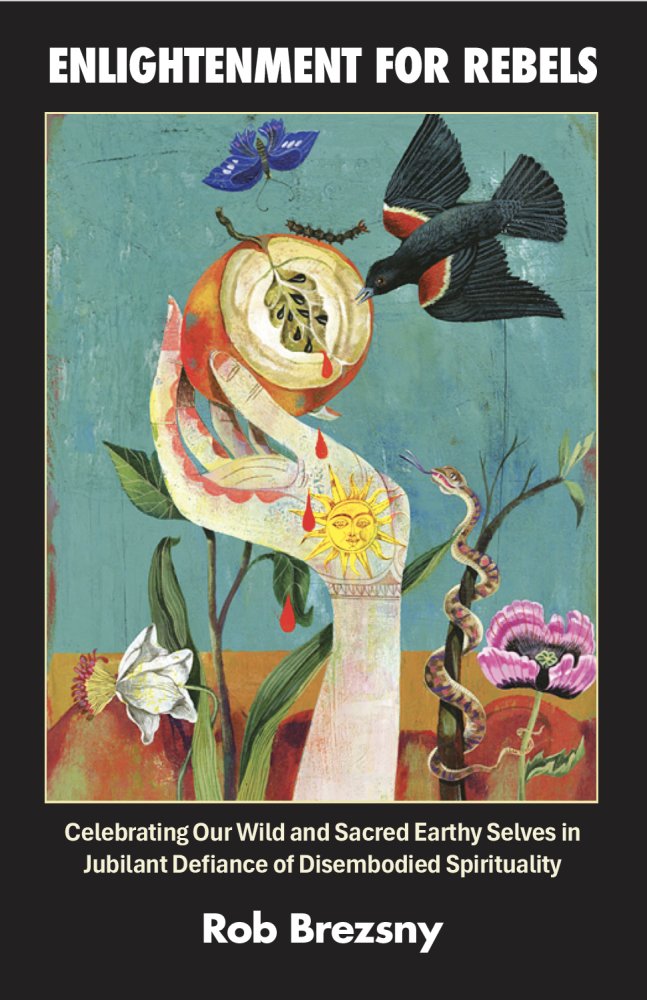
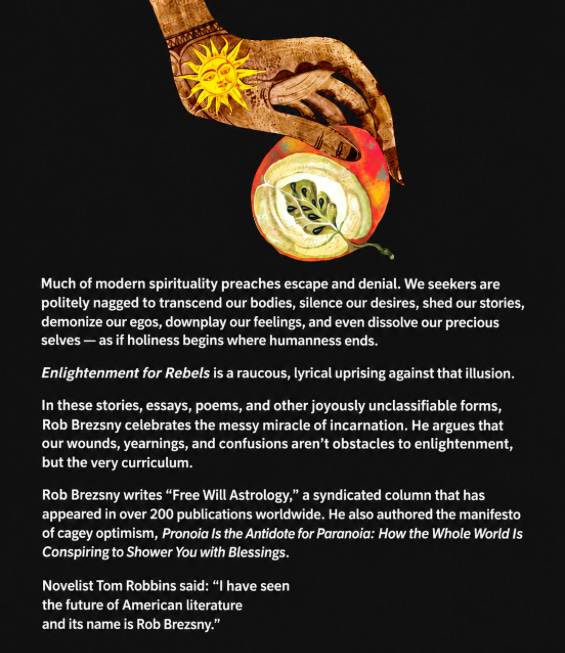
The book’s cover art is by Olaf Hajek.
PLEASURE, BLISS, ECSTASY, AND GLEEFUL ZEST AS SPIRITUAL FUEL
Many spiritual systems the world has inherited regard pleasure, bliss, rapture, ecstasy, elation, and related super treasures as troublemaking distractions. The so-called “lower self” is greedy for such wasteful irrelevance, the saintly authorities say. “Begone foul deceivers!” they imply or declare outright.
How many zillions of us have been taught, often with dire and threatening tones, that feeling really good leads us away from life’s essential goals? Holiness and sanctity are likely to accumulate in us only if we shun the supposedly inferior temptation to bask in delight.
Of all the idiocies foisted on humanity, this one is among the most egregious. We are in danger of veering into apoplexy as we contemplate such a criminal delusion. We’ll try to be civil.
In both our extensive mythic explorations of dreamy truth and our scientific investigations of hard-core reality, we have gathered incontrovertible evidence that pleasure is a central necessity for any spiritual quest that actually works.
It’s a sensory instrument. A tuning fork. A feedback system. A way the body says, Yes, this. More of this. Keep headed in this direction. You’re getting closer to home.
We’re not talking about the jittery sugar-high of addiction or the perverse, jangly thrills that sabotage health.
We mean the rich, ennobling euphoria and exhilaration that arise during encounters with smart fun: inspiring us to love ourselves more, expanding our capacity to love others, leading us in the direction of our shining dreams, and helping us solve our knotty problems.
The eruptions of these life-giving nourishments might come through the stimulation of our senses, emotions, mind, or imagination. They don’t yank us away from the sacred. They are among the sacred’s favorite ways of snagging our attention. Evolution didn’t give us many reliable compasses, but these are among them.
Our comprehensive research reveals that when we feel genuinely good—not inflated or superior, but resoundingly buoyant—our ethics improve. We’re more patient and curious. Less brittle and defensive.
When we’re swooning or even just shimmering with delectation, we see other people more clearly. They’re not obstacles or mirrors of our lack, but fellow creatures doing their best with the weather systems inside them.
By contrast, chronic deprivation, especially when dressed up as virtue, tends to make people tight and pinched and resentful of anyone who looks like they’re enjoying themselves.
Self-denial doesn’t reliably produce saints. Often it just produces people who are very good at pretending they don’t want what they want.
Those who know how to feed themselves often have a super-capacity to give without keeping score. Their generosity leaks out sideways. There’s surplus.
Here’s our very-well proven hypothesis: Compassion grows less from being twisted up about suffering and more from inhabiting joie de vivre so fully that we want others to feel it too.
I apologize for the mistreatment you have endured from so many teachers who regard themselves as spiritual leaders.
They have turned you into a villain in the human story, blaming you for every excess and distortion, as if you were nothing more than a flaw to transcend rather than an instrument to refine.
I acknowledge that you have sometimes tweaked my destiny and sent me wandering down dead-end paths I wished later I hadn’t followed. You have periodically caused me problems—like everything else life brings us!
But the more important truth is this: You were the first architect of selfhood. You’re the brave little maker of continuity, stitching together memory, longing, wound, and wonder into a coherent somebody.
Thank you for caring how others perceive me. It has helped me learn the social art of being among others: how to listen for feedback and how to recognize that I am immersed in a web of mutual reflection.
Thank you for letting me believe I can make a difference in the world, whether that belief is objectively true or gloriously delusional. Without that presumption, I might never have risked making art, offering love, speaking truth, or attempting repair.
Thank you for not letting me disappear behind counterfeit humility.
Thank you for resisting the temptation to make myself small in order to seem agreeable or spiritually evolved.
Thank you for the self-promotion, for the sometimes awkward, sometimes necessary declaration: I am here. I made this. It matters to me. Maybe it will matter to you.
Thank you for pushing me to crave validation through my acts of service. Even if the motives are mixed, a lot of good things still gets done. Care still circulates and healing happens. Plus: Motives can be composted into cleaner motives over time.
Thank you for helping me to be singular. I love being one peculiar, unrepeatable human being with preferences, hungers, aversions, and passions.
Thank you for reminding me that self-interest may be the sacred instinct of preservation.
Thank you for delightfully reminding me I have a story during the good times and the bad. A narrative, however imperfect and fragmentary, gives shape to chaos. It helps me locate myself in the vast glorious turmoil of life.
Thank you for my drive to be “successful,” and for allowing that marker to evolve. What once meant applause may now mean integrity. What once meant achievement may now mean depth.
Thank you for pushing me to take myself seriously enough to cultivate my gifts with devotion. Not because I am more important than others, but because my particular offering is mine to tend.
Thank you for helping guide my decisions and reveal my fears. Your defensiveness and ambitions are often diagnostic. They show me where I’m attached and unfinished.
Thank you for questioning the collective trance around me. You encourage me to refuse to dissolve into the herd. You help me cultivate discernment when consensus becomes conformity.
Thank you for letting me be human and messy. For letting me contradict myself, embarrass myself, overreach, recover, and try again.
And thank you for carrying the impossible burden of being the temporary steward of a mortal life.
You’re not the whole of me, but you’re an essential part of me. You’re a companion to educate and a wild animal to befriend.
With gratitude,
Your Soul
★
In composing this Love Letter to Our Egos, I was inspired by Dawn Robertson. Thanks, Dawn!
THE SHINING TEMPLE OF THE ANNIHILATED EGO
In my dream, I am riding in the back seat of a souped-up tour bus in southern France. The name of this fancy vehicle is the World Riddle.
I’m traveling along a road known as L’Autoroute du Soleil, the Motor-way of the Sun. Our destination is a tourist trap called Le temple resplendissant de l’ego anéanti, translated as the Shining Temple of the Annihilated Ego. It’s a shrine that the tour advertisements tout as being devoted to “le culte de l’individualité éteinte,” or “the worship of extinguished selfhood.”
What the hell does that mean? I’m not sure. I’m thinking it may have to do with the Sanskrit word “nirvana,” whose literal definition is “the blowing out of a flame.”
Many of our fellow travelers on the bus are religious disciples dressed in robes and sackcloth. I see Buddhist monks and nuns, Christian monastics, Hindu mendicants, and turban-wearing Sikh Brahmgianis.
In contrast, I’m dressed in red leather pants, an orange silk shirt, a sparkly gold vest studded with opalescent beads, and a black ankle-length cashmere coat. I’m also wearing rings on all my fingers.
★
I recognize the person sitting to my right. He’s Shunryu Suzuki, the well-known Zen master whose books helped popularize Zen Buddhism in America. Years ago, I read every word the man published.
In person, he looks conventional. He’s wearing a dull brown suit and narrow striped blue tie that make him look like a business executive from the 1950s.
This is a welcome opportunity for me. For years, I have had a bone to pick with him. In one of his books, he told a story about the importance of keeping one’s ego under strict control. A student had asked him, “How much ego do you need?” Suzuki’s austere reply was, “Just enough so that you don’t step in front of a bus.”
I felt reverence for that hard-ass attitude years ago when I first came upon it as a young spiritual punk. But later, I came to regard it as puritanical, pretentious, and retrograde. At this moment, piqued by his presence, I feel peeved about it.
It takes a while to work up the nerve, but I finally initiate a conversation with Mr. Zen.
“Long-time listener, first-time caller,” I say to him, copping the approach of a person who has reached a radio talk show host on the phone. “Loved Zen Mind, Beginner’s Mind. Made it my bible for a while.” That was Suzuki’s first book.
“Probably better not to make any book your bible,” he replies, in a tone that is neither friendly nor dismissive.
“Don’t worry. I’ll always love you, but I’ll never worship you.”
“There’s nothing here to worship, anyway,” he says, gesturing toward his torso. “I don’t even exist.”
“Good. I will keep that in mind if I feel any pangs of desire to turn you into a holy icon.”
“Have you ever tried it?” he asks. “Not existing?”
“Well, that idea is a pet peeve of mine,” I say. “As it turns out, I eventually discovered that I preferred existing to not existing. That’s when I had to burn your books down at the beach and take your photo down from my altar.”
“I’m sorry to hear that,” he says. “I mean the part about you preferring to exist. Burning my books and banishing my image were not unwise.”
“I’ve always wanted to ask you a question,” I say. “Do you mind?”
“I’m not sufficiently here right now to say yes or no. You are free to proceed.”
“Remember how you said that no one needs much of an ego; that the best ego size is just big enough to keep one from getting hit by a bus, but no bigger?”
“I recall that a mirage resembling me once said something like that.”
“I wonder if you would consider the possibility that maybe your old advice could benefit from revision. I mean, yes, I acknowledge that the ego is the root of much sour mischief. Maybe as much evil as the craving for wealth and control.”
“In Christian terms,” Suzuki interrupts, “it’s the original sin.”
“Yeah. Even for me, some of the stupidest and cruelest things I’ve done could be blamed on my infected and inflamed ego.”
“Which is why it’s better to live without it,” he says. “Purge that nasty pest completely.”
“I don’t agree,” I say. “I think the ego has crucial redemptive uses. And besides, just because it’s potentially dangerous doesn’t mean that spiritual seekers like us should nuke it.”
“Redemptive uses? Like providing you with the fuel to become an all-knowing rich and famous and powerful sex god?”
“No. Like providing me with the fuel to become a compassionate and creative and curious devotee of the Great Mystery.”
Suzuki makes a sound that might be mistaken for a chortle. “The ego appropriates those noble aspirations and turns them into disguised versions of being an all-knowing rich and famous and powerful sex god.”
“Well, sorry to be so blunt, but that’s how a fundamentalist thinks,” I press. “It would be like me practicing abstinence because I’m afraid of the chaos I might stir up by risking the gifts that sex affords me.”
Suzuki chuckles derisively, but I am unflustered. I’ve argued with famous people before. David Bowie didn’t take it personally when I questioned his feminism. Playwright David Mamet was annoyed when I asked him what specific events had turned him into a rightwing jerk, but he didn’t punch me.
“Instead of repressing the ego,” I say, “we should sublimate its brute force. Use all our best psychological tricks to transform its greed into generosity. And turn it into a beautiful work of art.”
“Good luck with that delusional fantasy,” Suzuki says.
“How about this?” I say. “Let’s be spiritual artisans who devote ourselves to crafting exquisite egos. And let’s do it with the same rigor and panache as a great actor who’s preparing to play the role of Buddha or Joan of Arc. Let’s add ‘egos’ to the list of beautiful artifacts that talented creators produce, along with songs, books, films, sculptures, paintings, electronic games, and dances.”
“What you propose,” he replies, “is like putting lipstick and mascara on a donkey. Or worse yet: on a lipsticked and mascara’d donkey that has explosives strapped to its body like a suicide bomber.”
I don’t feel defensive in the least. On the contrary, I’m delighted he’s fighting back.
“You’re on the wrong side of history,” I tell him cheerfully. “Like the reactionary traditionalists who are quite sure that all humans are one of only two genders.”
“So what do we have here?” Suzuki snorts. He’s getting emotional! “A staunch advocate for the rights of the ego! Good for you, you brazen rebel. The ego has been the victim of appalling oppression over the centuries. I am glad someone is defending its honor.”
“I’m not defending the honor of all the arrogant assholes who have mangled history with their megalomaniacal cruelty,” I say, as serene and amused as a meditator in a mountaintop sanctuary. “I’m proposing a crucified and resurrected ego, a gorgeous and lyrical and empathetic ego that’s a gift to humanity.”
“I’m guessing,” Suzuki sneers, “that someone with your views must have a deep attachment to the phantasms we Zen Buddhists refer to as ‘self ’ and ‘individuality.’ Am I right?”
“I’m more aligned with Gurdjieff ’s position,” I reply. “While it’s possible to create an electric, enduring, beauty-drunk individuality, many people don’t want to work that hard.”
“And am I right to assume you regard that electric, enduring beauty-drunk individuality as permanent and immortal? Going to live forever, are you, my young friend?”
“Yes, I am, thank you. And so you are, too.”
“No, thanks,” he scoffs. “My laughable hallucination of unique selfness has a future appointment with the worm-rich dirt. Good riddance.”
“I’ll bet you a trillion nirvanas that you and I meet again at the end of time.”
“You don’t have a trillion nirvanas to bet.”
“Are you sure about that?”
Suzuki shouts, “Immortality sucks!”, grabs my face with his hands, and smacks his skull into mine, knocking me backward and propelling me out of sleep.